A new KSO season. Four pieces. Four forces shaping whatever lives beneath the third horn chair.
It has been a while since I documented the universes.
They never really stopped forming, of course. Rehearsals happened. Concerts happened. Water keys were emptied. Entire civilizations presumably rose, discovered agriculture, developed questionable systems of government, invented social media, immediately regretted it, and vanished without anyone bothering to document their existence.
I have been negligent.
But tonight begins another season with the KSO, and when I looked down between my feet before the concert, there it was again.
Creation.
Several young universes were already taking shape across the floor, waiting for the music to decide what they would become.
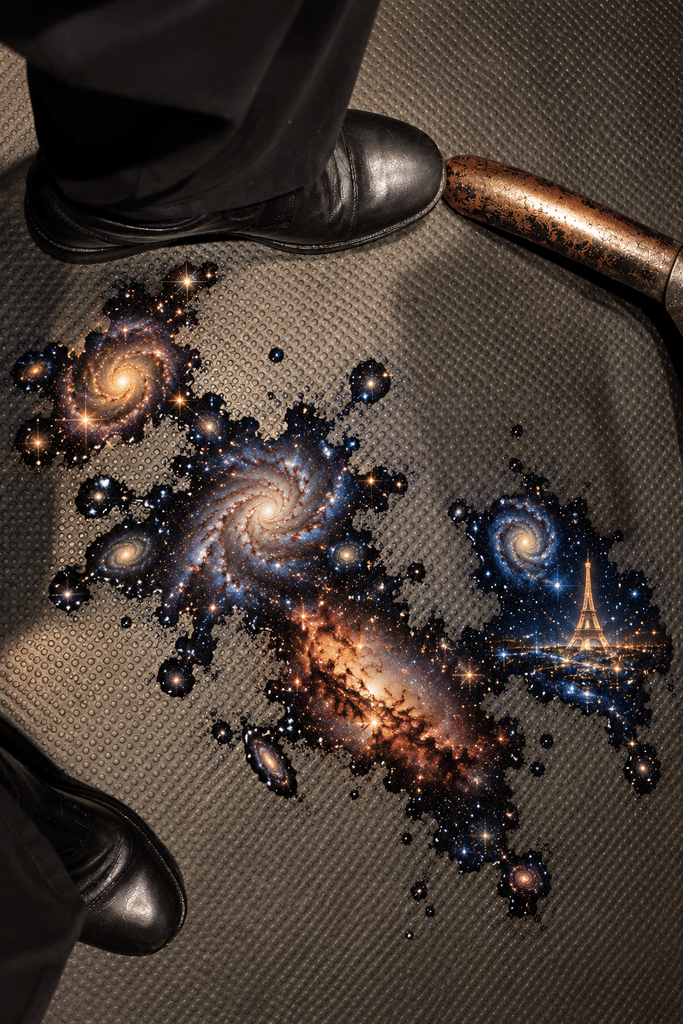
Before the first note: young galaxies forming beneath the third horn chair. The Creator surveys his work.
And looking at tonight’s program, these poor little civilizations had absolutely no idea what was coming.
First, happiness.
We began with Nicky Sohn’s Is This the Happiest Place on Earth?
That’s a dangerous question to ask a newly formed civilization.
Imagine being only a few billion years old. Stars still cooling. Planets barely assembled. Your species has just figured out fire, and suddenly the Creator sends a piece hurtling through your cosmos asking whether everybody is happy.
There was energy. Curiosity. Light.
New stars ignited. Young civilizations looked outward for the first time and wondered what else might be out there. Somewhere down there, I suspect a species invented amusement parks almost immediately.
They believed they had achieved happiness. Eventually they discovered parking fees. Their innocence ended.
Then Dvořák arrived.
The Cello Concerto changed everything.
These universes suddenly acquired memory. There were old worlds now. Oceans. Mountains. Distance. Civilizations that left home and civilizations that stayed behind. People looking into their night sky wondering what became of someone they once loved on a planet they could no longer reach.
Because Dvořák doesn’t merely give a universe beauty. He gives it longing.
The cello sang across billions of light-years, and somewhere inside those little galaxies, beings who had existed for perhaps fourteen minutes discovered nostalgia. Cities were built. People left them.
Songs were written about coming home, Some did. Some didn’t.
The universes were growing up.
William Grant Still gave them history.
Then came the Afro-American Symphony.
Now these civilizations inherited something heavier than memory. They inherited history. Rhythm entered their bones. Their music began carrying stories older than the people performing it. Generations spoke to generations.
These were no longer pristine little galaxies sparkling harmlessly on an orchestra floor. They had struggled now. They had endured. And they created anyway.
Their music contained sorrow without surrendering to it and joy without requiring the past to be forgotten. Somewhere in one of those tiny worlds, someone looked backward. Someone else looked forward.
And through music, for a moment, they understood that they were part of the same story. That’s civilization.
And then Gershwin took everybody to Paris.
This seems irresponsible.
After happiness, longing, history, and generations of cultural development, An American in Paris arrived and apparently decided: You people need a vacation.
Suddenly the galaxies lit up. Cities appeared. Traffic became inexplicably musical.
Some civilization invented the taxi horn and immediately concluded that this was an acceptable orchestral instrument.
There was jazz in the streets. Light reflected from wet pavement. People moved everywhere. Cultures collided. New ideas arrived faster than anyone could process them.
After everything these universes had been through tonight, Gershwin gave them motion. And possibility.
Somewhere beneath my chair, a young alien arrived in Paris, fell hopelessly in love, missed the last train home, and decided it had been the greatest day of its life. Which, come to think of it, brought us directly back to the question we started with.
Is This the Happiest Place on Earth?
Maybe. Maybe not.
Perhaps happiness was never supposed to be a place. Maybe it’s everything that happens along the way.
Joy. Longing. History. Movement. The ridiculous, beautiful accumulation of experiences that turns existence into a life.
And then the final note disappeared.
I looked down.

After the concert: the same floor, but not the same universes. Billions of years have passed. The Creator remains. There was considerably more universe than when we started. Some galaxies had expanded. Others had collided. New ones had appeared in the spaces between.
And somewhere inside all of that, countless civilizations had lived through the entire program. They had asked whether they were happy.
They had loved and longed with Dvořák. They had inherited history from Still. They had gone to Paris with Gershwin. They built cities. Made art. Fell in love. Went to war. Came home. Left again. Looked into their night skies and wondered whether someone else was looking back.
Billions of lives. Billions of stories. Entire histories played out beneath a chair in the horn section over the course of one KSO concert.
And tomorrow, someone will probably mop the floor. There is something magnificently unfair about that. But perhaps that’s the point. Music works the same way.
We spend weeks preparing it. Years learning how to make it. We walk onto a stage and bring something into existence that has never existed in precisely that form before.
For a couple of hours, it lives. Then the last note sounds. The audience leaves. The stage goes dark. And it’s gone. Except for whatever it changed while it was here.
So the season has begun. The universes are forming again. And apparently I’m still responsible for them.
Third horn… Tonight … Creator of worlds. Destroyer of civilizations.
Occasional emptier of spit. Until the next gig.
© 2026, Robert Owen. All rights reserved.